
LabNoxis GLP-1
from €210.00
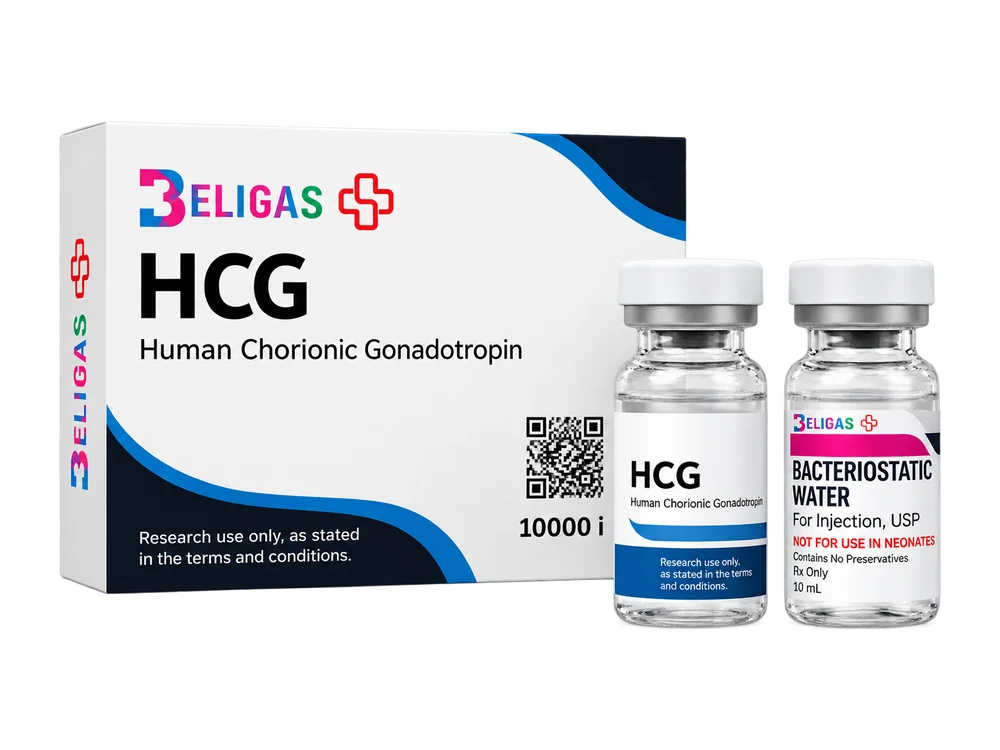
Peptide
Human chorionic gonadotropin · Beligas
€70.00
In stock Ships within 24h on working days
| Classification | Glycoprotein hormones, alpha polypeptide |
|---|---|
| Dosage | 500 to 3000 IU, 1 to 3 times per week |
| Acne | Possible |
| Water retention | No |
| HBR | No |
| Hepatotoxicity | No |
| Aromatization | No |
| SKU | LN-HCG10 |
All products are supplied for research, analytical and educational purposes only. They are not intended for human consumption, medical use, diagnosis, treatment or prevention of any condition. By ordering you confirm you are of legal age and that the purchase, possession and use of these products comply with the regulations that apply where you are.
Human chorionic gonadotropin is a hormone produced by the placenta after implantation. It is studied alongside androgen cycles for its luteinising-hormone-like activity, and appears in fertility and endocrine research.
HCG is a single chain of 237 amino acids with three intramolecular disulphide bridges. It is not a steroid but a naturally occurring peptide hormone.
Luteinising hormone (LH) is a gonadotropin, and acts on the same receptor. LH is produced in the pituitary and has a beta chain of 115 amino acids and an alpha chain of 89. Follicle-stimulating hormone (FSH) is also a gonadotropin, sharing the same 89-amino-acid alpha chain, and its production and release are controlled by gonadotropin-releasing hormone.
Protocols in the literature range from 500 to 4000 IU, typically given three times per week, with some regimes running longer than a year.
In the context of androgen cycles, reported use is 250 to 500 IU one to three times per week, raised to 500 to 1000 IU two to three times per week ahead of post-cycle therapy.
By mimicking luteinising hormone, HCG is reported to support endogenous testosterone production, testicular size and function, and sperm production. It appears in post-cycle protocols intended to limit the suppression caused by anabolic steroids. In fertility research it is studied for stimulating ovulation.
Its use for weight loss alongside calorie restriction is documented but remains contested.
Raising endogenous testosterone also raises the substrate available for aromatisation into estrogen, so elevated estrogen is the main reported concern. Associated effects include gynecomastia, mood change and water retention. Aromatase inhibitors appear in the literature as the usual countermeasure.
For research, analytical and educational use only. Not for human consumption.
from €210.00
from €39.00